
On Wednesday 17 June, the All-Party Group secretariat was delighted to support researchers from Ulster University as they presented new research on the relationships between gambling, sport, marketing, and harm at an event at Parliament Buildings, Stormont. The event was hosted by Danny Donnelly MLA, APG secretary. Drawing on recent UKRI- and Department for the Economy-funded work, the session took the form of a series of short presentations aimed at policymakers and practitioners.
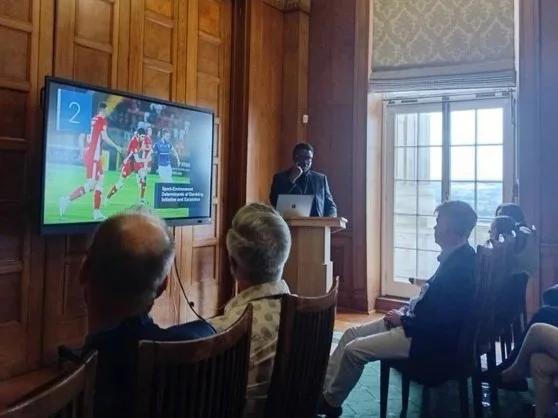
Dr Tunde Adebisi shared findings from the UKRI Rapid Evidence Review on the dynamics that encourage gambling initiation and escalation within sports organisations.
Existing literature suggests that gambling is often introduced and sustained through social norms, peer influence, and club cultures. The availability of online gambling makes it easy to act on gambling opportunities.
Researchers frequently talk about sponsorship and advertising without measuring exposure in detail. And much of the existing research continues to focus almost entirely on individual responsibility, rather than the structural or environmental factors such as the design of gambling products or advertising and marketing.
This Rapid Evidence Review is intended to identify future research priorities. Dr Adebisi emphasised that we need more studies that follow people over time, to better understand their journeys into gambling; stronger evidence about environmental exposure; and stronger partnerships between researchers and sporting organisations.
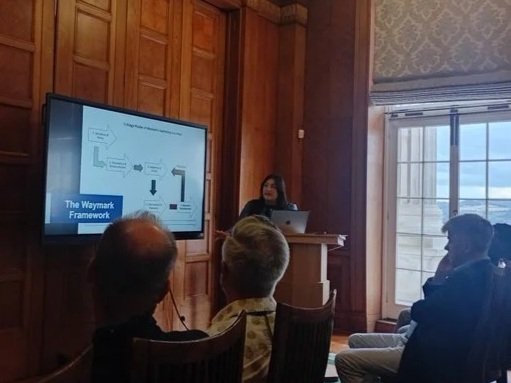
Dr Erin McEvoy presented the WAYMARK framework, a model mapping women's gambling journeys and harm alongside potential intervention points. This was developed through her Department for the Economy-funded PhD.
WAYMARK describes five steps:
Initiation and Entry
Escalation and Entrenchment
Addiction and Crisis
Intervention and Recovery
Recovery Maintenance
Crucially, gambling journeys are cyclical, from exposure to addiction, recovery, and relapse.
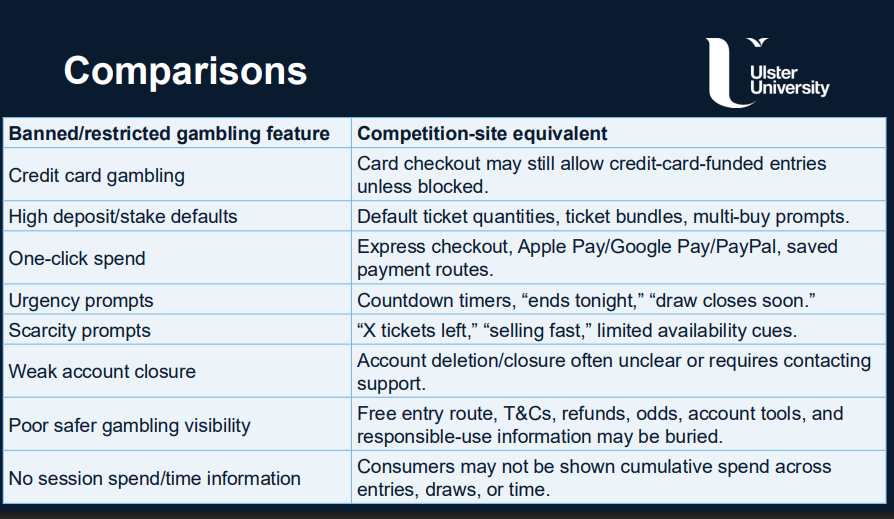
Dr Paul Kitchin highlighted the regulatory challenges posed by "Competition Websites", or prize draws, which have proliferated across Northern Ireland since 2020.
These sites make use of “dark patterns”, deceptive design used to sustain consumer engagement. Many of these practices are banned for licenced remote gambling.
Finally, Elisha Arbuckle, an Enterprise Placement Year student at the University, provided an overview of her gambling-harm-awareness animation, developed from research on the risks of financial harm and the barriers to seeking help.