
On Tuesday 23 June, the All Party Group on Reducing Harm Related to Gambling welcomed Anne Marie Caulfield, Chief Executive of the Gambling Regulatory Authority of Ireland (GRAI) to Parliament Buildings. Ms Caulfield briefed the APG on the establishment of the GRAI and the phased roll-out of Ireland’s new regulatory regime.
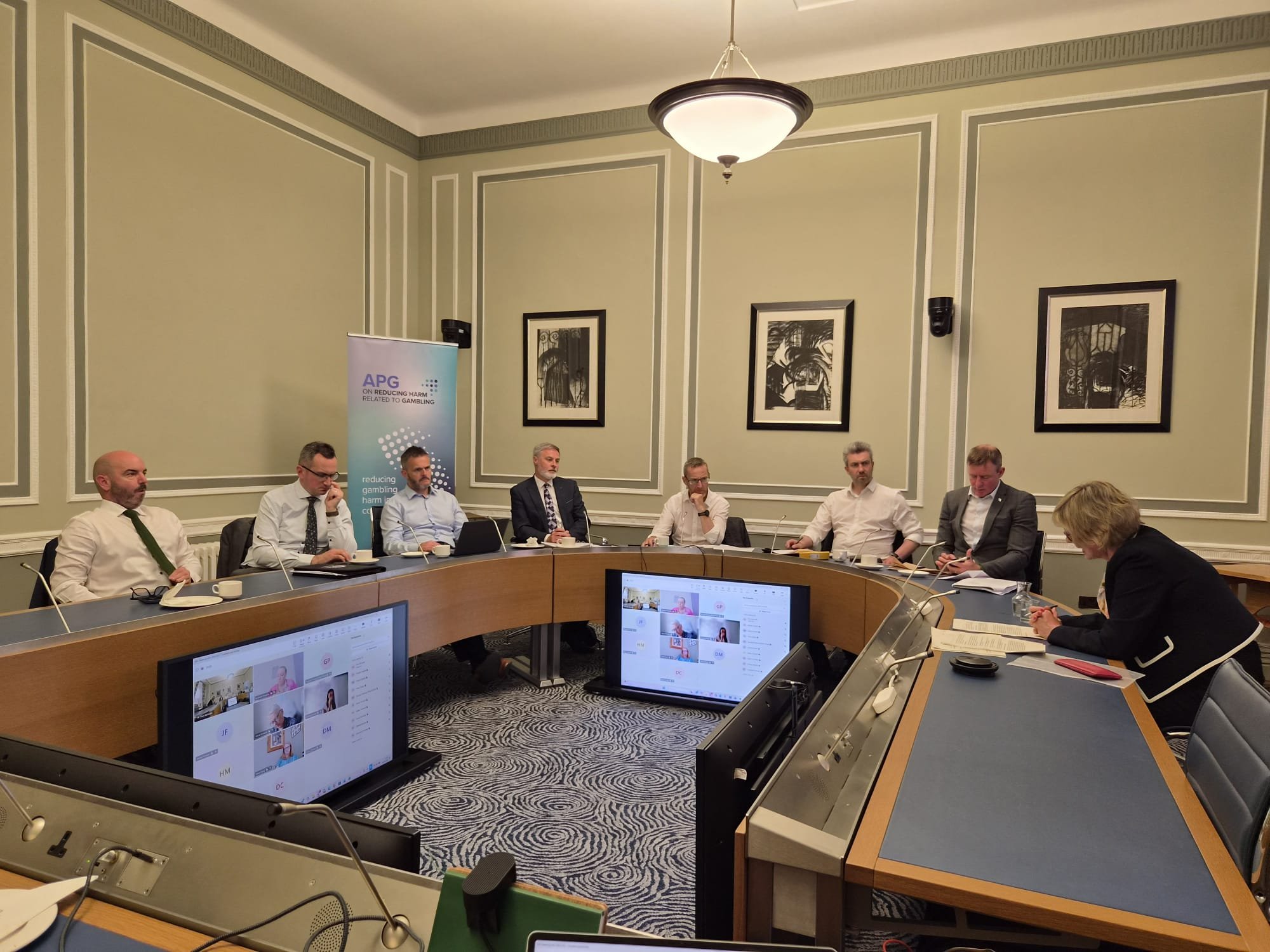
From left to right: David Honeyford MLA (Alliance, Lagan Valley), Stephen Dunne MLA (DUP, North Down), Robbie Butler MLA (UUP, Lagan Valley), Paul Frew MLA (DUP, North Antrim), Philip McGuigan MLA (Sinn Féin, North Antrim), Danny Donnelly MLA (Alliance, East Antrim), Justin McNulty MLA (SDLP, Newry and Armagh), Anne Marie Caulfield (Chief Executive of the Gambling Regulatory Authority of Ireland).
Summary of discussion with Anne Marie Caulfield, GRAI CEO
Establishing the GRAI
Ms Caulfield began by emphasising that the GRAI has a strong public health focus. The Gambling Regulation Act 2024, taken through the Oireachtas by then-Minister James Browne, replaced the patchwork of outdated statutes on gambling and was designed to protect children and at-risk adults. The seven-person Authority, chaired by Paul Quinn, has powers to make further regulations and codes of practice to respond quickly to emerging risks.
Ms Caulfield was appointed as CEO-designate of the GRAI in September 2022, well before the legislation passed. Ms Caulfield told MLAs they started with a three-person team, and then recruited others with expertise in gambling, law, finance, HR, and ICT, over time. They were also supported by a cross-departmental programme board within the Department of Justice. Ms Caulfield said they benefitted greatly from this approach, as it allowed them to put structures in place and begin procurement well before the Act was passed, allowing the regulator to become operational without delay.
Ms Caulfield also praised the advice and support the GRAI received from the GB Gambling Commission and the Gambling Regulators European Forum (GREF). The GRAI are meeting regularly with the Gambling Commission; however, Northern Ireland has not been part of those discussions.
Roll out of new licencing regime
The GRAI is rolling out new licences for different gambling activities on a phased basis. The first licences, for remote betting, go live on 1 July 2026, with on-site betting licences following on 1 December. The next phase will focus on gaming, including electronic gaming machines; a public consultation on the new licencing regime will run later this year, ahead of new licences going live in 2027. All new licence types, including lottery licences, will be in place by 2028.
New consumer protections
As licences go live, operators must comply with new obligations, including monthly spend limits set by the customer, stronger know-your-customer and age-verification requirements, anti-money-laundering checks, a prohibition on targeting inducements at individuals, a ban on credit for gambling, and restrictions on on-site ATMs. The GRAI is also developing a National Gambling Exclusion Scheme (covering remote gambling only), which is at an early design stage.
Failure to comply with licence requirements may result in penalties including fines of up to €20m or 10% of turnover (whichever is lower), or the suspension or revocation of licence.
The GRAI has a strong focus on protecting children from harm. Ms Caulfield said recent research conducted by the ESRI, as part of their partnership with GRAI, demonstrated that those who had gambled as a child were twice as likely to suffer from gambling harm as an adult. Provisions in the legislation to protect children include making it a serious offence to allow children to gamble, a watershed and adverts from 5.30am to 9pm, a prohibition on ads making gambling attractive to children, and banning clothing or merchandise with gambling branding being made for children or distributed at events which may be attended by children.
During the discussion, MLAs asked about protections such as affordability checks for customers showing signs of harmful gambling. Ms Caulfield said that while there will be a requirement for consumers to set spending limits, this is a tool to assist people to control their gambling. However, currently, affordability checks are not a requirement. Though Ms Caulfield explained that the Authority does have the ability to introduce new measures if they are deemed necessary, and there will be a 3-year review of the Gambling Regulation Act, so it can recommend new primary legislation if needed.
She also highlighted that protections need to be seen as part of wraparound supports, noting there are black market operators who publicise the fact that they do not have spending limits, accept credit cards, and are not on Gamban.
MLAs also asked if the lack of adequate regulation in NI creates a risk of gambling operators migrating to this jurisdiction to escape regulation. Ms Caulfield said that in terms of on-site gambling, they have no evidence of that to date, but said it would be something to monitor for the future.
Social Impact Fund
The GRAI is preparing to introduce a Social Impact Fund in partnership with Pobal (the state-funded community and public sector support body), which will fund treatment, education and awareness, and research into gambling harm. It will be financed by a mandatory levy on commercial licensees. Ms Caulfield said a strategy for the fund, shaped by five focus groups spanning lived experience, families, NGOs, healthcare professionals and education groups, has been submitted to the Minister for Justice, who is expected to announce the levy and timelines very shortly.